
Best Home EV Chargers in the UK (2026): Smart Tariffs, Safety, and the Apps That Actually Work
Last updated: March 1, 2026
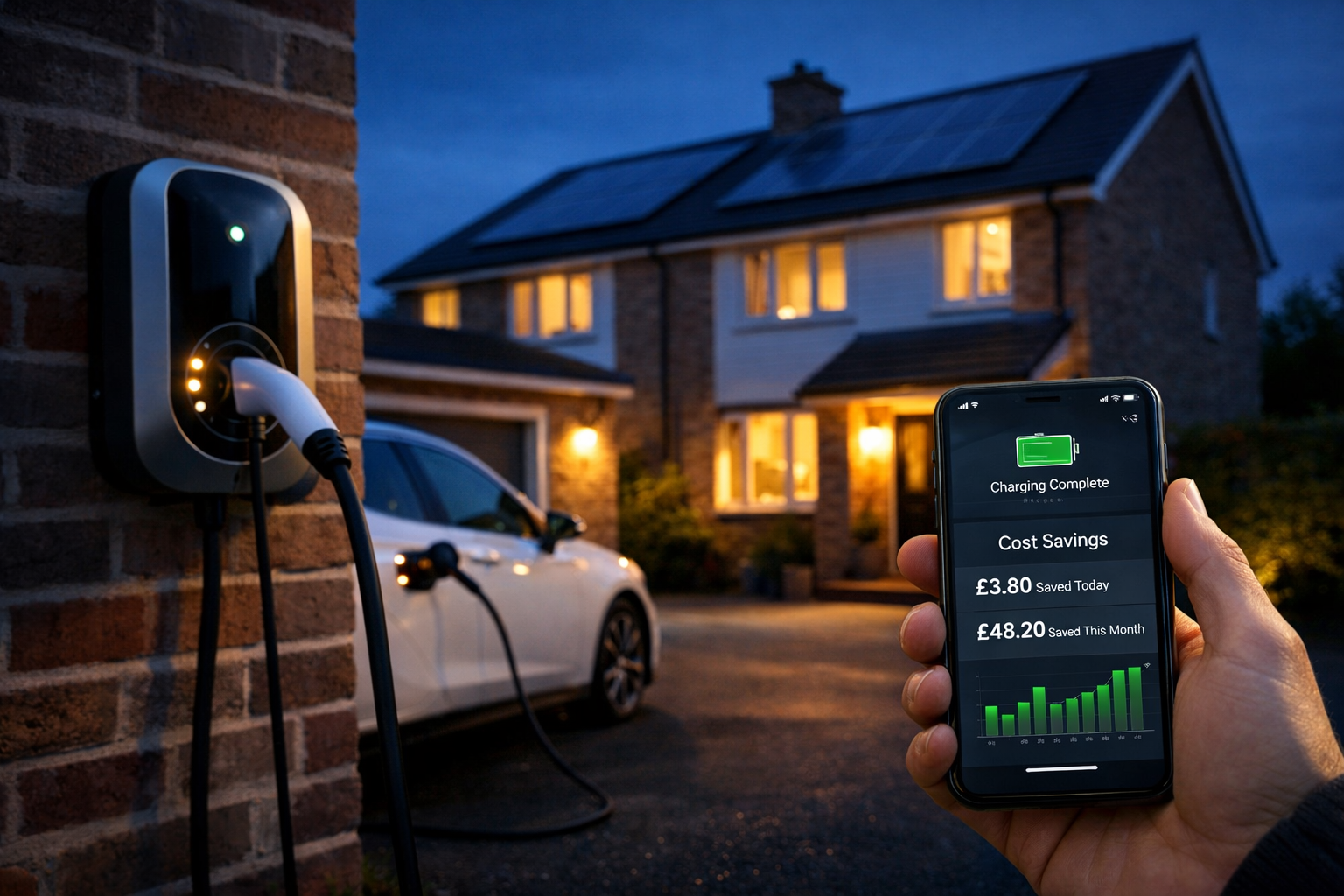
You’ve just bought an electric car. Brilliant. Now you need to charge it at home without haemorrhaging money on peak-rate electricity or wrestling with an app that crashes every third session. The best home EV chargers UK homeowners are installing in 2026 aren’t just about pumping electrons into your battery… they’re about smart tariff integration, bulletproof safety standards, and apps that actually remember your charging schedule. Here’s how to choose one that fits your driveway, your energy tariff, and your tolerance for faff.
Key Takeaways
- Smart tariff compatibility is the biggest cost differentiator in 2026… chargers with deep API integration (Ohme, Hypervolt) unlock rates as low as 7p/kWh versus 24p+ on standard tariffs
- 7kW charging is the sweet spot for UK homes… 22kW three-phase is pointless for 99% of driveways and most EVs can’t accept it anyway
- Octopus Intelligent Go introduced a six-hour charging cap in early 2026, changing which chargers deliver maximum savings
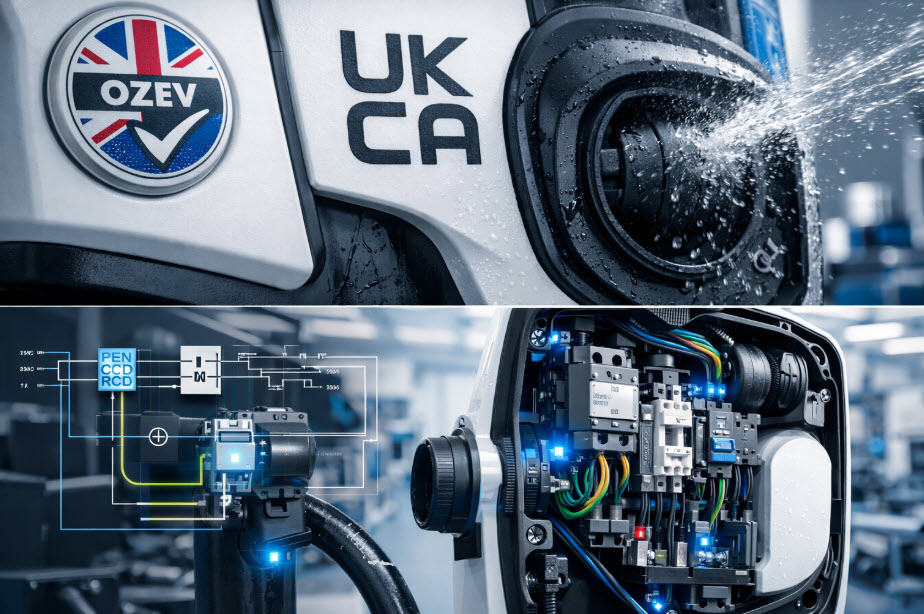
- PEN fault protection is now standard on OZEV-approved units, eliminating the need for expensive earth rods in most installations
- App quality varies wildly… Ohme and Hypervolt lead for reliability, whilst budget units often ship with clunky interfaces that fail mid-charge
- Solar integration requires specific hardware… only Zappi and a handful of competitors offer true solar diversion, not just scheduling
- Installation costs range £500–£1,200 depending on your consumer unit location, but the February 2026 grant boost covers £500 for eligible renters and flat owners
- Tethered vs untethered is a lifestyle choice… tethered is tidier and faster to plug in, untethered is more flexible if you swap cars or need different cable lengths
- UKCA and OZEV approval are non-negotiable… anything without these certifications won’t qualify for grants and may not meet Building Regulations
- Planning permission was scrapped in May 2025 for most home charger installations under Permitted Development Rights
Quick Answer
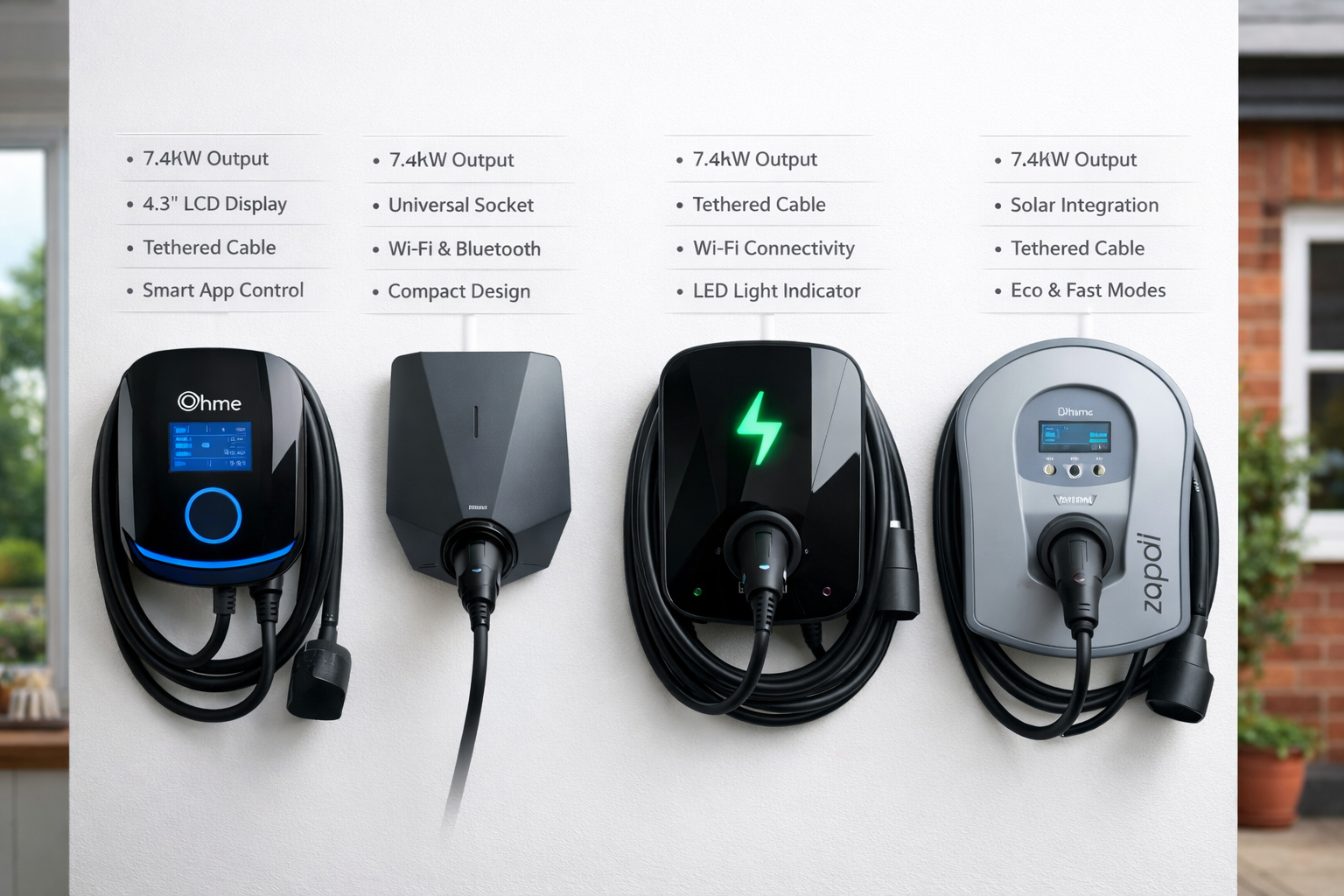
The best home EV chargers UK buyers are choosing in 2026 depend on your energy setup. For maximum tariff savings, Ohme Home Pro dominates with direct API links to Octopus, OVO, and British Gas, tracking costs per session down to the penny. If you have solar panels, myenergi Zappi offers proper solar diversion alongside smart scheduling. For bulletproof reliability and weatherproofing, Hypervolt Home 3 Pro leads with the lowest fault rates and a polished app. Budget-conscious buyers wanting simplicity should consider Pod Point Solo 3S or Easee One, both offering solid performance without premium pricing. Tesla owners get seamless integration with the Tesla Wall Connector, though it lags behind dedicated smart chargers for tariff automation.
Why Your Charger Choice Matters More in 2026
Choosing the right home EV charger in 2026 isn’t just about plugging in and hoping for the best. The gap between a smart charger optimised for UK energy tariffs and a basic unit has widened to hundreds of pounds annually in running costs. Here’s why your decision carries more weight than it did even two years ago.
Smart Tariffs Changed the Rules
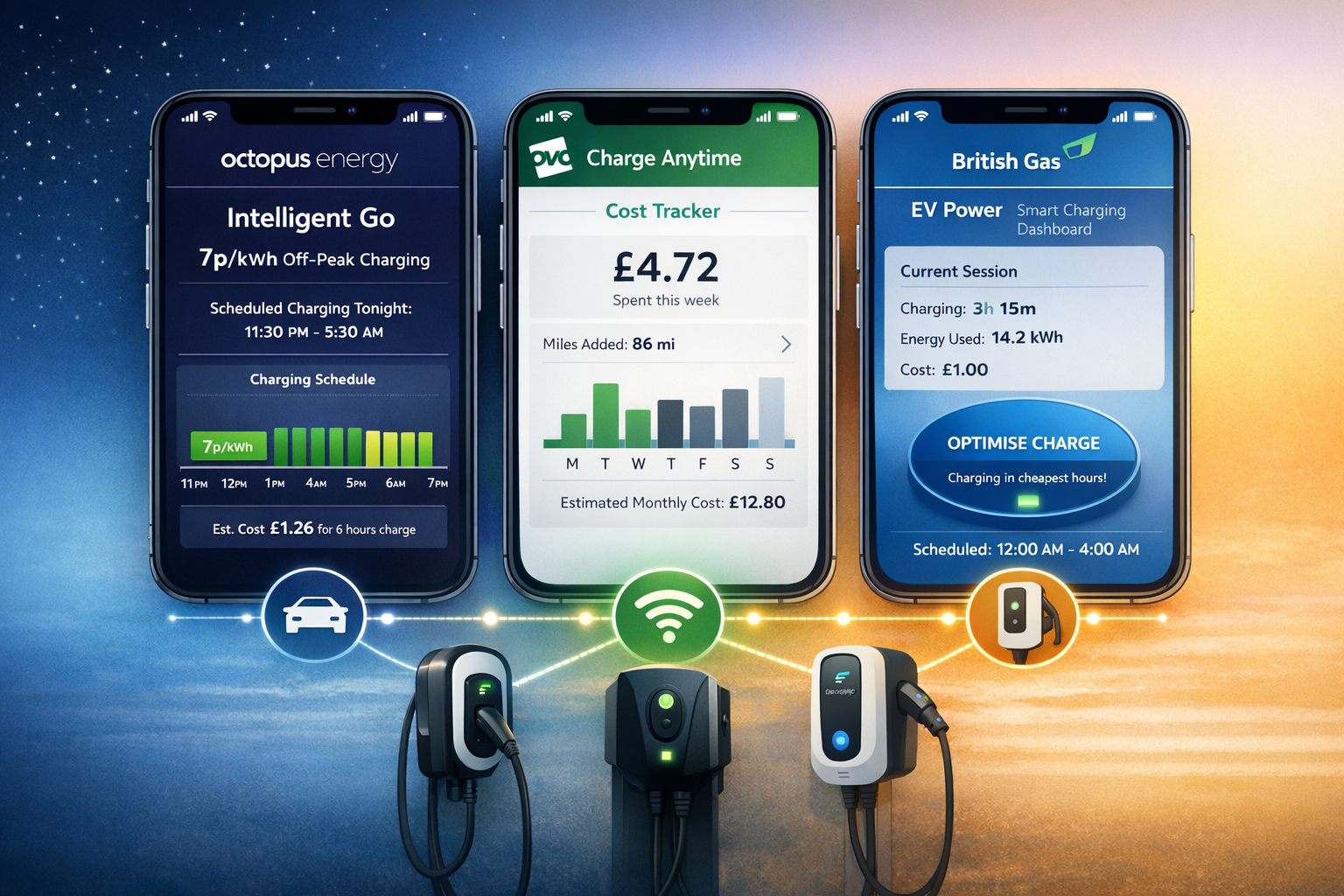
Smart tariffs have shifted from “nice to have” to “financially essential” for most EV owners. Octopus Intelligent Go, OVO Charge Anytime, and British Gas EV Power all offer off-peak rates around 7p/kWh… compared to standard variable rates hovering near 24p/kWh in early 2026. That’s a 70% saving if your charger can actually talk to your energy supplier’s API.
Here’s the catch: not all chargers integrate equally. Ohme Home Pro and Hypervolt Home 3 Pro offer deep API connections that automate scheduling based on real-time tariff windows, grid demand, and your departure time. Budget chargers often rely on manual timers or car-based scheduling, which can miss dynamic pricing windows or fail to adapt when tariff rules change.
In February 2026, Octopus introduced a six-hour charging cap on Intelligent Go sessions, limiting how much cheap electricity you can draw in a single overnight window. Chargers with smarter load management (like Easee One and Ohme) can split sessions across multiple off-peak windows to maximise savings, whilst basic units just hit the cap and stop.
The 7kW Reality Check (Why You Don’t Need 22kW)
Most UK homes run on single-phase 230V supplies, delivering a maximum of 7.4kW to your charger. Three-phase 22kW chargers are marketed as “future-proof” but they’re pointless unless you’ve got a commercial supply or a very specific property setup… which costs thousands to install and benefits almost nobody.
In practice, 7kW charging adds roughly 30 miles of range per hour for a typical EV. Plug in overnight for six hours and you’ve added 180 miles… more than enough to refill a daily commute. Even long-range EVs with 75kWh batteries can fully charge from 20% to 100% in under nine hours at 7kW, well within a standard overnight window.
The only scenario where 22kW makes sense is if you’re running a fleet of vehicles on a commercial site with three-phase power already installed. For typical British homeowners, paying extra for 22kW capability is like buying a lorry to do the school run… technically impressive, completely unnecessary.
Quick Comparison Table
← Scroll sideways to see full table →
| Charger | Unit Price | Installed | Tethered? | Smart Tariff | Solar | IP Rating | App | Our Verdict |
|---|---|---|---|---|---|---|---|---|
| Ohme Home Pro | £535 | £1,035–£1,235 | Both | Excellent | No | IP54 | 4.6/5 | Best for tariff savings |
| Easee One | £449 | £949–£1,149 | Both | Good | Basic | IP54 | 4.5/5 | Best all-rounder |
| Andersen Quartz | £995 | £1,495–£1,695 | Untethered | Basic | No | IP65 | 4.2/5 | Best looking, pricey |
| Pod Point Solo 3S | £499 | £999–£1,199 | Both | Good | No | IP65 | 4.3/5 | Best for simplicity |
| Myenergi Zappi | £599 | £1,099–£1,299 | Both | Good | Excellent | IP65 | 4.6/5 | Best for solar |
| Hypervolt Home 3 Pro | £690 | £1,190–£1,390 | Tethered | Excellent | Basic | IP65/IK10 | 4.7/5 | Best for durability |
| Tesla Wall Connector | £425 | £925–£1,125 | Tethered | Fair | No | IP44 | 4.4/5 | Best for Tesla owners |
Installed prices assume typical UK domestic installation (consumer unit within 10m, no major electrical upgrades). Prices accurate as of March 2026.
The Best Home EV Chargers for 2026
These are the chargers actually worth installing on your house in 2026, ranked by real-world usability, tariff integration, and whether the app will still work in six months.
Ohme Home Pro… Best for Smart Tariff Savings
Output 7.4kW
Cable Both options
App 4.6/5
Ohme Home Pro is the undisputed smart tariff king in 2026. It’s the only charger with direct API integration to Octopus Intelligent Go, OVO Charge Anytime, and British Gas EV Power, meaning it automatically schedules charging during the cheapest windows without you lifting a finger. The app tracks cost per session down to the penny, shows historical usage, and adjusts schedules when tariff rules change.
Here’s how it works: connect your Ohme account to your energy supplier, set your departure time, and the charger handles the rest. If Octopus opens a bonus cheap window at 2am because grid demand drops, Ohme starts charging. If the six-hour cap is approaching, it splits the session intelligently. You wake up to a full battery and a notification showing you paid £1.80 instead of £7.50.
The downside? No native solar integration. If you’ve got panels on the roof, Ohme can’t divert surplus generation to your car… it only optimises around tariff pricing. For solar owners, Zappi is the better pick.
Easee One… Best All-Rounder
Output 7.4kW
Cable Both options
App 4.5/5
Easee One is the charger that just works without drama. It’s compact (the size of a shoebox), supports OCPP 2.1 for future-proofing, and offers load balancing if you later add a second charger or solar battery. The app is clean, reliable, and doesn’t require a PhD to configure.
Smart tariff integration is good but not excellent… you’ll need to set manual schedules or rely on your car’s built-in timers for dynamic pricing. It does support basic solar integration through load balancing, but it’s not as sophisticated as Zappi’s dedicated solar diversion mode.
Andersen Quartz… Best Looking Charger on the Market
Output 7.4kW
Cable Untethered
App 4.2/5
Andersen Quartz is the charger you buy when you care about how it looks on your house. It’s a minimalist aluminium rectangle available in custom colours (including RAL-matched finishes to blend with your brickwork), and it genuinely looks like a piece of design rather than industrial kit bolted to your wall.
The 7-year warranty is the longest in the UK market, and build quality is exceptional. But here’s the problem: at £995 for the unit alone, you’re paying a £400–£500 premium over functionally equivalent chargers like Easee or Pod Point. Smart features are basic… just a timer, no API integration, no solar diversion.
Pod Point Solo 3S… Best for Simplicity
Output 7.4kW
Cable Both options
App 4.3/5
Pod Point Solo 3S is the charger for people who just want to plug in and charge. The app is straightforward, scheduling is simple, and it integrates reasonably well with Octopus and OVO tariffs through manual timer setup. It’s not as automated as Ohme, but it’s also £200 cheaper installed.
The unit itself is IP65-rated for weatherproofing and comes with a 3-year warranty. Installation is typically quick because Pod Point’s network of approved installers is one of the largest in the UK, often meaning shorter wait times for booking.
Myenergi Zappi… Best for Solar Panel Owners
Output 7.4kW
Cable Both options
App 4.6/5
Zappi is the only charger that genuinely integrates solar generation and smart tariff scheduling in one unit. It monitors your solar output in real-time and diverts surplus energy to your car before it exports to the grid. If the sun goes behind a cloud, it seamlessly switches to grid power (ideally during a cheap tariff window).
You can set three modes: Eco mode (solar only, charging pauses when generation drops), Eco+ mode (solar priority, topped up from grid if needed), or Fast mode (grid power regardless). In practice, Eco+ is the sweet spot… you maximise free solar charging during the day, then top up overnight on Octopus Intelligent Go if needed.
The app is excellent, showing live solar generation, grid import/export, and charging status on a single screen. Installation requires a CT clamp on your consumer unit to monitor generation, adding about £50–£100 to labour costs.
Hypervolt Home 3… Best for Durability and Weatherproofing
Output 7.4kW
Cable Tethered
App 4.7/5
Hypervolt Home 3 Pro has the lowest fault rate of any charger in the UK market according to What Car?’s 2025 reliability survey (still relevant into 2026). It’s built like a tank, rated IP65 for water resistance and IK10 for impact resistance… meaning it’ll survive a football to the face or a decade of British weather without flinching.
Smart tariff integration is excellent, with direct API links to Octopus and OVO. The app is polished, responsive, and hasn’t had a major outage in over 18 months. Load balancing is built-in, and PEN fault protection is standard (no earth rod needed in most installations).
The main downside is price… you’re paying £100–£200 more than Easee or Pod Point for the same 7.4kW output. But if you value reliability and weatherproofing, that premium buys peace of mind.
Tesla Wall Connector… Best for Tesla Owners (Obviously)
Output 7.4kW*
Cable Tethered
App 4.4/5
Tesla Wall Connector is the obvious choice if you own a Tesla and want the tidiest integration. It talks directly to your car via Wi-Fi, receives over-the-air firmware updates, and shows charging status in the Tesla app alongside everything else.
But here’s the catch: it relies on car-based scheduling for smart tariff integration, not charger-based API links. That means you’re setting timers in your Tesla app rather than letting the charger automatically optimise around dynamic pricing windows. It works fine for simple overnight charging on Octopus Go, but it’s less sophisticated than Ohme or Hypervolt for maximising savings.
The unit itself is well-built, rated IP44 (adequate for covered driveways, less robust than IP65 competitors), and comes with a 4-year warranty. At £425 it’s competitively priced.
*Supports up to 22kW but limited to 7.4kW on single-phase supply.
Smart Tariffs Explained… and Why They Should Drive Your Decision
Smart tariffs are the single biggest running cost differentiator for home EV charging in 2026. The gap between charging on a standard tariff and a smart EV tariff is roughly £800–£1,200 per year for a typical driver covering 10,000 miles annually. Here’s how the main UK tariffs work and which chargers integrate best.
Intelligent Octopus Go (and the 2026 Six-Hour Cap)
Octopus Intelligent Go offers 7p/kWh during off-peak windows (typically 11:30pm–5:30am) versus 24p/kWh peak. It’s the most popular smart EV tariff in the UK, and for good reason… the app is slick, integration is automatic, and you can request bonus cheap slots during the day if you need a top-up.
The six-hour charging cap introduced in early 2026 limits how much energy you can draw in a single overnight session. For most EVs with 60–75kWh batteries, this isn’t a problem… six hours at 7kW delivers 42kWh, enough to charge from 20% to 90%. But if you’re regularly charging from near-empty, or you drive a large EV like a Mercedes EQS, you might hit the cap.
Chargers with smart load management (Ohme, Hypervolt) can split sessions across multiple off-peak windows to work around the cap. Basic chargers just stop when the limit is reached, leaving you to manually restart charging at peak rates if you need more range.
Best chargers for Intelligent Octopus Go: Ohme Home Pro (direct API, automatic scheduling), Hypervolt Home 3 (direct API, load balancing), Easee One (manual scheduling, reliable).
OVO Charge Anytime
OVO Charge Anytime takes a different approach: you plug in whenever you like, and OVO automatically charges your car during the cheapest six-hour window they can find overnight. The rate is a flat 7p/kWh during those windows, regardless of when they occur.
The clever bit: you don’t set schedules. Just plug in, and OVO’s algorithm finds the cheapest slots based on wholesale energy prices and grid demand. In practice this means charging usually happens between midnight and 6am, but it can shift earlier or later depending on grid conditions.
Best chargers for OVO Charge Anytime: Ohme Home Pro (direct API, automatic), Hypervolt Home 3 (direct API), Pod Point Solo 3S (manual timer as backup).
British Gas EV Power
British Gas EV Power offers 7p/kWh for five hours overnight (typically 12am–5am) and 27p/kWh the rest of the day. It’s straightforward, predictable, and works well if you have a consistent routine.
The downside: it’s less flexible than Octopus or OVO. The cheap window is fixed, so if you get home late or need to charge at odd hours, you’re stuck paying peak rates. It’s best for people with regular schedules who can reliably plug in before midnight.
Best chargers for British Gas EV Power: Ohme Home Pro (direct API), Easee One (manual timer), Tesla Wall Connector (car-based scheduling).
Which Chargers Work With Which Tariffs
Not all chargers integrate equally with all tariffs. Here’s the breakdown:
- Direct API integration (automatic scheduling): Ohme Home Pro, Hypervolt Home 3 Pro
- Good integration (manual scheduling or OCPP support): Easee One, Pod Point Solo 3S, Myenergi Zappi
- Basic integration (timer only, or car-based scheduling): Andersen Quartz, Tesla Wall Connector
If you’re serious about minimising running costs, direct API integration is worth paying for. The difference between automatic scheduling and manual timers is hundreds of pounds annually, plus the convenience of never having to think about it.
Safety and Compliance… What to Look For
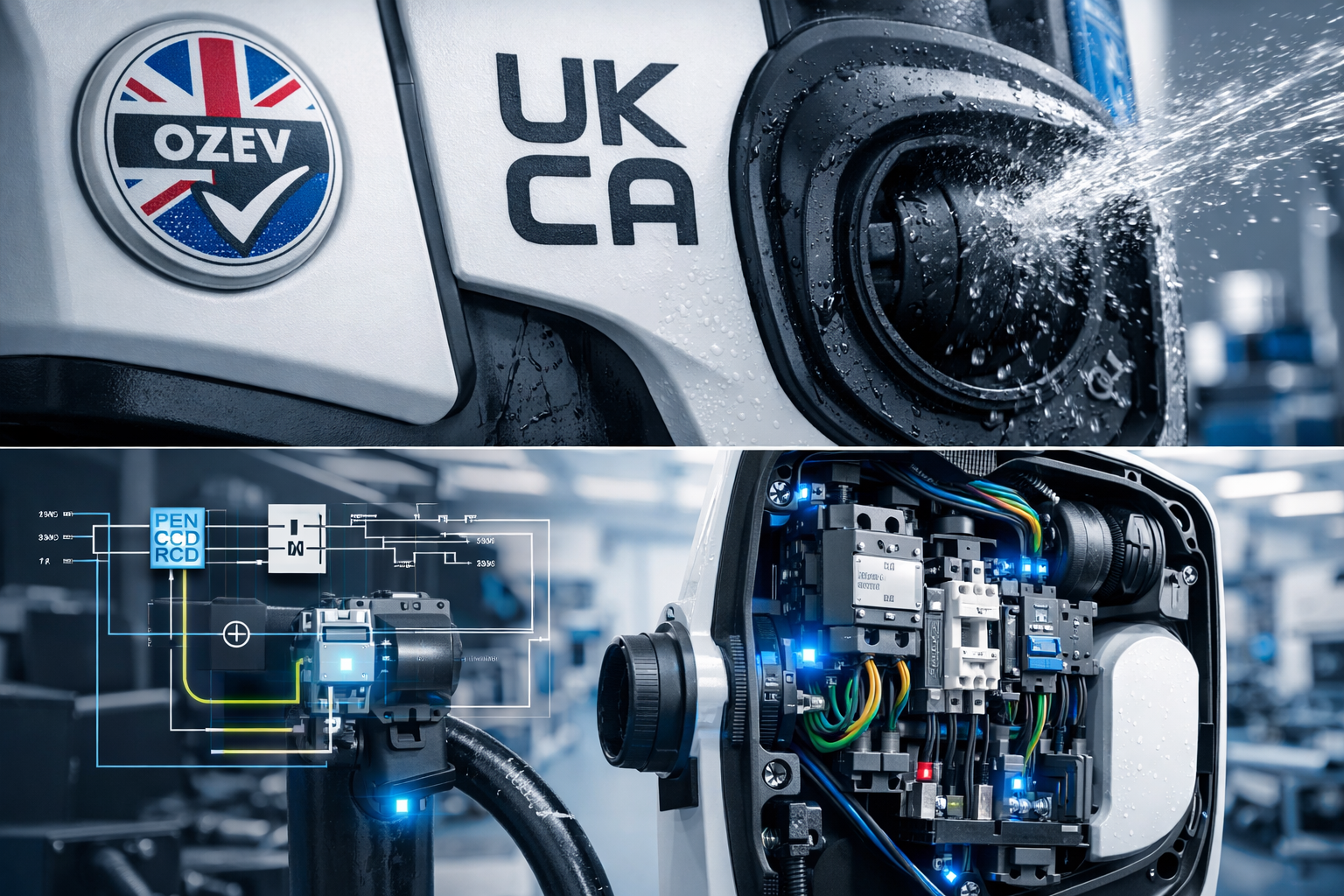
Safety standards for home EV chargers tightened significantly in 2025–2026, driven by stricter OZEV requirements and updated Building Regulations. Here’s what actually matters when evaluating charger safety.
OZEV Approval and UKCA Certification
OZEV approval is mandatory for any charger installed under the Electric Vehicle Chargepoint Grant (extended to March 2027 in February 2026). It certifies the charger meets UK safety standards, includes smart functionality, and has been independently tested.
UKCA certification (UK Conformity Assessed) replaced CE marking post-Brexit and confirms the charger complies with UK electrical safety regulations. Any charger without UKCA is technically illegal to install after January 2023, though enforcement has been patchy.
In practice: stick to OZEV-approved chargers from recognised brands (Ohme, Hypervolt, Easee, Pod Point, Zappi, Andersen, Tesla). Avoid grey-import units or budget brands without clear UK certification… they might be cheaper upfront, but they won’t qualify for grants and may fail Building Control inspection.
PEN Fault Protection (and Why Earth Rods Are Mostly Dead)
PEN fault protection detects when the combined Protective Earth and Neutral conductor (common in UK TN-C-S supplies) loses its earth connection, creating a shock risk. It’s now mandatory on all OZEV-approved chargers installed after July 2022.
Older installations required an earth rod (a metal spike driven into the ground to provide an independent earth), adding £200–£400 to installation costs. Modern chargers with built-in PEN fault detection eliminate this requirement in most cases, cutting installation costs and hassle.
Hypervolt Home 3 and Zappi both include PEN fault protection as standard. Ohme Home Pro, Easee One, and Pod Point Solo 3S also comply. If an installer quotes you for an earth rod in 2026, ask why… it’s usually unnecessary unless your property has a very unusual electrical setup.
IP and IK Ratings… Weatherproofing That Actually Matters
IP ratings measure protection against water and dust. For outdoor chargers in the UK, you want IP54 minimum (protected against dust and splashing water) or ideally IP65 (dust-tight and protected against water jets).
IK ratings measure impact resistance. IK08 withstands 5 joules of impact (equivalent to a 1.7kg weight dropped from 30cm), adequate for most driveways. IK10 withstands 20 joules (a 5kg weight from 40cm), useful if your charger is exposed to footballs, bicycles, or clumsy reversing.
Hypervolt Home 3 leads with IP65 / IK10, making it the most weatherproof and impact-resistant option. Zappi, Pod Point, and Andersen all offer IP65. Ohme and Easee are IP54, adequate but less robust. Tesla Wall Connector is only IP44, fine for covered driveways but vulnerable if fully exposed to the elements.
Which Charger Is Right for You?
Choosing the best home EV charger UK installation for your specific situation comes down to four main scenarios.
You Want the Cheapest Running Costs
Pick: Ohme Home Pro
Direct API integration with Octopus, OVO, and British Gas means automatic scheduling during the cheapest tariff windows, tracking costs per session, and adapting when tariff rules change. Over a year, this saves £200–£400 versus manual scheduling.
Alternative: Hypervolt Home 3 Pro offers similar tariff integration with better weatherproofing, but costs £150 more installed.
You Have Solar Panels
Pick: Myenergi Zappi
It’s the only charger with true solar diversion, automatically routing surplus generation to your car before exporting to the grid. You can also schedule overnight top-ups on cheap tariffs if solar alone doesn’t fill the battery.
Alternative: Easee One offers basic load balancing for solar, but it’s not as sophisticated as Zappi’s dedicated solar modes.
You Just Want Something That Works
Pick: Easee One or Pod Point Solo 3S
Both are reliable, straightforward, and don’t require a degree in electrical engineering to configure. Set a simple overnight schedule once and forget about it.
Alternative: Tesla Wall Connector if you own a Tesla and want the tidiest integration with the car’s app.
You Care About How It Looks
Pick: Andersen Quartz
The only charger designed by someone who cares about aesthetics. Custom colour matching, minimalist design, and a 7-year warranty. But you’re paying £400–£500 extra for the privilege.
Alternative: Easee One is compact and unobtrusive if you want something that blends in without the premium price.
Common Mistakes When Buying a Home EV Charger
These are the errors that cost UK homeowners hundreds of pounds or leave them stuck with a charger that doesn’t fit their needs.
Paying for 22kW on a Single-Phase Supply
Most UK homes have single-phase 230V supplies, maxing out at 7.4kW. Three-phase 22kW chargers are marketed as “future-proof” but they’re useless unless you pay thousands to upgrade your supply… which benefits almost nobody.
If an installer quotes you for a 22kW charger, ask whether your property actually has three-phase power. If not, save your money and buy a 7.4kW unit.
Ignoring Smart Tariff Compatibility
Buying a charger without checking how it integrates with your energy tariff is like buying a car without checking the fuel economy. The difference between direct API integration (Ohme, Hypervolt) and basic timers (Andersen, budget units) is £600–£1,000 annually in running costs.
Letting the Installer Choose for You
Many installers push specific charger brands because they get better margins or faster delivery, not because the charger is best for your needs. Always choose your own charger based on your tariff, solar setup, and budget, then find an installer who’ll fit it.
Forgetting About App Quality
The app is how you’ll interact with your charger every day. A clunky, unreliable app turns charging into a chore. Ohme, Hypervolt, and Zappi all have excellent apps with high reliability and regular updates. Pod Point and Easee are solid. Andersen’s app is basic but functional.
Budget chargers often ship with apps that crash, fail to update schedules, or lose connection mid-charge. Check app store reviews before buying… if the app has a sub-4.0 rating, that’s a red flag.
Installation, Grants, and What to Expect in 2026
Typical Installation Costs
A standard home EV charger installation costs £500–£700 for labour and materials, assuming your consumer unit is within 10 metres of the charger location and no major electrical upgrades are needed. Add the charger unit cost (£425–£995) for a total installed price of £925–£1,695.
Costs increase if:
- Your consumer unit is more than 10m from the charger location (£50–£150 per additional metre for cabling)
- You need a consumer unit upgrade to add capacity (£300–£600)
- Your supply needs upgrading from single-phase to three-phase (£2,000–£5,000… almost never worth it)
- Difficult access or complex routing is required (£100–£300)
Get three quotes from OZEV-approved installers before committing. Prices vary significantly by region and installer.
OZEV Grants… Who Still Qualifies?
The Electric Vehicle Chargepoint Grant was extended to March 2027 in February 2026, with the subsidy increased from £350 to £500 per socket. But most homeowners no longer qualify… the grant is now targeted at:
- Renters (with landlord permission)
- Flat owners in blocks with dedicated parking
- Homeowners without off-street parking (if installing a charger on-street with council approval)
- Businesses and charities installing workplace chargers
If you own a house with a driveway, you’re not eligible. The grant is claimed by the installer, not the customer, so it’s automatically deducted from your invoice if you qualify.
Planning Permission Is Gone (Since May 2025)
The May 2025 update to Permitted Development Rights removed the planning permission requirement for most home EV charger installations. You can now install a charger on your property without notifying the council, provided it:
- Is installed on a wall or post within your property boundary
- Doesn’t exceed 1.6m in height (wall-mounted) or 2.3m (post-mounted)
- Isn’t in a conservation area or on a listed building (which still require approval)
This cuts installation timelines by 4–8 weeks and removes the £200–£400 planning application fee. If you’re in a conservation area or listed building, check with your local council before proceeding.
For more background on home EV charging fundamentals, see our ultimate guide to finding the best EV chargers for your home.
FAQ
What is the best home EV charger in the UK in 2026?
Ohme Home Pro is the best for smart tariff savings, Myenergi Zappi is best for solar panel owners, and Hypervolt Home 3 Pro is best for durability and weatherproofing. Choose based on your energy setup and priorities.
How much does a home EV charger installation cost?
Expect £925–£1,695 total (charger plus installation), depending on unit choice and installation complexity. Standard installations with consumer units within 10m of the charger location cost £500–£700 for labour.
Do I need a 22kW charger or is 7kW enough?
7kW is enough for 99% of UK homeowners. 22kW requires three-phase power (rare in domestic properties) and most EVs can’t accept it anyway. 7kW adds roughly 30 miles per hour, sufficient for overnight charging.
Which chargers work with Octopus Intelligent Go?
Ohme Home Pro and Hypervolt Home 3 Pro offer direct API integration for automatic scheduling. Easee One, Pod Point Solo 3S, and Zappi work with manual scheduling or car-based timers.
Can I install a home EV charger myself?
No. Home EV charger installation must be carried out by a qualified electrician and certified under Building Regulations Part P. DIY installation voids warranties, invalidates insurance, and is illegal.
What is PEN fault protection and do I need it?
PEN fault protection detects earth faults in TN-C-S electrical supplies, preventing shock risks. It’s mandatory on all OZEV-approved chargers since July 2022 and eliminates the need for earth rods in most installations.
How long does it take to charge an electric car at home?
At 7kW, expect roughly 30 miles of range per hour. A typical 60kWh EV battery charges from 20% to 80% in about 6–7 hours, easily achieved overnight on a smart tariff.
Do I still qualify for the OZEV grant?
Most homeowners with driveways no longer qualify. The grant (£500 per socket as of February 2026) is now limited to renters, flat owners, and homeowners without off-street parking. Businesses and charities still qualify.
Should I buy a tethered or untethered charger?
Tethered chargers have a permanently attached cable (tidier, faster to plug in). Untethered chargers require you to supply your own cable (more flexible if you swap cars or need different lengths). Choose based on convenience preference.
What’s the difference between Ohme and Hypervolt?
Both offer excellent smart tariff integration. Ohme Home Pro is £150 cheaper and has marginally better app features. Hypervolt Home 3 Pro is more weatherproof (IP65/IK10 vs IP54) and has the lowest fault rate in the UK.
Can I use my home EV charger with solar panels?
Myenergi Zappi is the only charger with true solar diversion, routing surplus generation to your car automatically. Easee One offers basic load balancing. Most other chargers (including Ohme and Hypervolt) don’t integrate with solar.
How much can I save with a smart EV tariff?
Typical savings are £800–£1,200 per year for a driver covering 10,000 miles annually, compared to charging on a standard variable tariff. Smart tariffs like Octopus Intelligent Go offer 7p/kWh off-peak versus 24p/kWh peak.
Conclusion
Choosing the best home EV chargers UK installation in 2026 comes down to matching the charger to your energy setup, not just picking the cheapest unit or the one your installer prefers. If you’re on a smart tariff (or planning to switch), Ohme Home Pro delivers the lowest running costs through direct API integration with Octopus, OVO, and British Gas. Solar panel owners should prioritise Myenergi Zappi for true solar diversion. If you value bulletproof reliability and weatherproofing, Hypervolt Home 3 Pro justifies its premium price. For straightforward, no-nonsense charging, Easee One or Pod Point Solo 3S offer solid performance without complexity.
The key decision factors: smart tariff compatibility (worth £600–£1,000 annually), solar integration (if you have panels), app quality (you’ll use it daily), and safety standards (OZEV approval and PEN fault protection are non-negotiable). Ignore marketing hype about 22kW charging unless you’ve got three-phase power, and don’t let installers upsell you on features you don’t need.
Get three quotes from OZEV-approved installers, choose your charger based on your specific needs, and check whether you qualify for the £500 grant (extended to March 2027). Planning permission is no longer required for most installations since May 2025, cutting timelines and costs.
The right charger, paired with the right tariff, turns your driveway into a refuelling station that costs a fraction of public charging or petrol. Choose wisely, and you’ll save thousands over the life of your EV.


